
Sea buckthorn - Hippophae rhamnoides
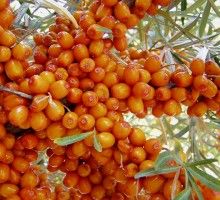
Sea buckthorn
Sea buckthorn is a deciduous shrub, commonly known in English as sea buckthorn.
NAME AND HISTORY
Although it has only become widely known in modern Greece in the 21st century, there are many references to it in the writings of Theophrastus, a pupil of Aristotle, and of Dioscorides, regarded by many as the father of pharmacology. Its name is essentially owed to a coincidence. During Alexander the Great's campaign deep into Asia, many horses were wounded, and it was noticed that those that ate from a particular shrub recovered faster and their coats became stronger and shinier. That shrub was sea buckthorn. Its Latin name comes from the Greek words hippos (horse) and phaes (from phaos, light or shine), meaning "shining horse".
DESCRIPTION OF SEA BUCKTHORN
There are 6 species of sea buckthorn and 12 native subspecies, all originating from across Europe and Asia. Most sea buckthorn cultivation takes place in China, where it is used to hold back floodwaters and prevent soil erosion. It is a shrub that grows from 0.6 to 6 metres tall, and in exceptional cases reaches 10 metres. It is highly tolerant of saline conditions in both soil and air. It needs abundant sunshine to grow and does not tolerate shade.
COMMON VARIETIES
Hippophae rhamnoides is by far the most widespread species on every continent. In Western Europe it dominates coastal areas thanks to its tolerance of salt spray from the sea, while in Central Asia it prevails in semi-desert areas where other plants cannot survive. In Central Asia and Europe it also often grows as a shrub above the tree line and in sunny places such as riverbanks. Sea buckthorn has dense, stiff, thorny branches. Its leaves are silvery-green and lance-shaped, 5–8 cm long and less than 6 mm wide. It is dioecious, with separate male and female plants. The male plants produce brown flowers and pollination takes place by wind.
FRUIT AND LEAVES
Female plants bear orange-yellow, fleshy berries 8–9 mm in diameter – soft, juicy and rich in oils. The berries are an important food source for many birds.