
Blueberry - Vaccinium corymbosum
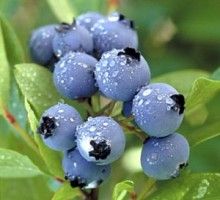
Blueberry
The blueberry is a plant that can be grown in every region of Greece. It is valued for its fruit, which is rich in substances beneficial to the human body, including antioxidants and many vitamins. The berries are eaten both fresh and processed.
The blueberry plant can be cultivated throughout Greece, because some varieties need less winter chill while others need more – and Greece has regions suited to all of them. The world's largest blueberry producer is the USA, followed by Canada and then the Netherlands, Poland and Ukraine. Blueberries are blue in colour and can be eaten straight from the bush, or packed and frozen. Besides their wonderful flavour, the substances they contain are reported to support human health, and scientific research suggests they may have beneficial properties in a range of conditions. Blueberries are also used in many products, either as a main or a secondary ingredient, by the pharmaceutical, food and cosmetics industries.
Health properties of the blueberry: blueberries are known for their high antioxidant content. 100 grams of blueberries provide around 50 calories, making them a moderate-calorie food – neither very light nor heavy. They are low in sugar and high in water, which makes them very refreshing, and their dietary fibre content supports healthy digestion. Their constituents have also been studied for a possible role in helping to protect against prostate, breast, mouth and colon cancer, as well as age-related conditions such as Parkinson's and Alzheimer's disease.
Blueberries are also said to benefit eyesight! During the Second World War, RAF pilots reportedly ate large quantities of blueberry jams and sweets in the belief that it helped them spot German aircraft. Beyond eyesight, blueberries are traditionally said to help with indigestion, nausea, diarrhoea and diabetes – in the case of diabetes, they are reported to help lower blood sugar.
How blueberries are processed
Blueberries are mostly sold fresh, straight after harvest. They can, however, be processed in various ways: into desserts and toppings, yoghurt, juice concentrate and essential oils. They can also be frozen or dried.
Growing blueberries
In Greece, highbush blueberries are planted mainly in spring. On the islands of southern Greece, thanks to the somewhat higher temperatures, they can be planted from mid-autumn to early spring. Plants may be bare-root or container-grown and should be placed in a sheltered spot, as wind dries out blueberry roots very easily. The best-performing plants are those grown on for 1 to 1.5 years; nursery stock should be 1 to 3 years old at most and of the highest possible quality.
A major advantage of the blueberry is that it can be grown on poor, relatively infertile land: it does not need high-quality soil or heavy fertilisation to thrive. Instead, small, regular applications of fertiliser are needed. Blueberries require nitrogen in moderate amounts, although high-yielding crops do need it. Small amounts of potassium and phosphorus are also required.
Blueberries need plenty of water: during the usually dry summer months they must receive at least 5 mm of water per week until the first autumn rains in early autumn. If it does not rain, the plants must be irrigated – but excessive rainfall can be equally damaging. In short, blueberries need a normal, steady supply of water.
Weed control is also essential and should be carried out on the land to be planted a few years in advance, using cultural, preventive, chemical, mechanical or biological methods. Blueberries are susceptible to various diseases and viruses that must be controlled. Birds are a major pest, as they find the fruit very attractive; they can be deterred with noise-making devices, scarecrows and netting. Harvesting is best done by hand rather than by machine.
Blueberries: costs and returns
Anyone considering blueberry cultivation should take the following economic factors into account. A plantation has a lifespan of around three decades. Approximately 160 plants are grown per stremma (1,000 m²), with an average yield of around 1,000 kg of fruit per stremma. Hand-harvesting costs around €700–1,000 per stremma, with a picker gathering about 5 kg per hour. Fruit takes 3 to 6 weeks to develop, depending on the variety, and the harvest runs through the summer months, from July to September. The fruit sells for around €4–5 per kilo. Establishing one stremma of highbush blueberries costs around €900–1,000, and the annual cost of growing, maintaining and harvesting a fully established stremma is around €1,500. Annual gross income is around €4,000–5,000 per stremma, with net income of €2,800–3,400 per stremma.
How blueberries are processed: blueberries are mostly sold fresh, straight after harvest. They can, however, be processed in various ways: into desserts and toppings, yoghurt, juice concentrate and essential oils. They can also be frozen or dried.
KEY GROWING METHODS AND TIPS
1) Cross-pollination (growing two or more varieties together) has been observed to increase fruit size by 30%. It is also recommended to have at least one beehive for every 2 stremmata of blueberries.
2) Blueberries can increase in size by 35% if left on the bush for a few more days after they are fully ripe.
3) Mulching the soil with sawdust in summer lowers the surface soil temperature and therefore the temperature of the roots. Note that blueberries keep developing their root system until the soil temperature reaches 16°C; mulching with sawdust allows the plant to continue growing straight after the summer.
4) Blueberries are grown in soils with a pH of 4.2–5.5 and an organic matter content of 4–5%.
5) If the soil pH is above 5.5, plants show iron deficiency; if it drops below 3.8, the leaf margins turn red due to soil toxicity caused by manganese and potassium deficiency.
6) Soil pH can be lowered by spreading 90% granular sulphur. Ideally, apply 25 kg per stremma in late winter and another 25 kg per stremma the following autumn.
7) Applying sulphur and nitrogen together is recommended, as the two work synergistically. Sulphur applied to the soil remains effective for 9–10 years.
8) Fertilising with ammonium sulphate (21-0-0)
In the second year after planting, give each plant 14–18 g, increasing the amount by 4–6 g each year until it reaches 36–48 g.
9) Blueberries also respond very well to potassium fertilisation in autumn.
4–6 kg per stremma with 22% potassium, 22% sulphur and 11% magnesium
10) Blueberry diseases and pests
Necrotic ringspot virus, botrytis (grey mould), bacterial blight, monilinia (mummy berry) and anthracnose.